Your job is at risk even when the company is profitable
Block just laid off 4,000 people. Revenue was up. Here’s what that means for you.

Block cut 40% of its global workforce this week. The business was growing. The stock jumped 24% the same day.
Let that sink in.
4,000 people out of 10,000 lost their jobs not because the company failed, but because it succeeded well enough to no longer need them.
This is the new layoff logic. And it’s coming for more companies. Probably yours.
Here’s what you need to understand, and what to do about it this week.
What Jack Dorsey just admitted out loud
In his memo to the company, Block CEO Jack Dorsey (founder of Twitter) wrote:
“The intelligence tools we’re creating and using, paired with smaller and flatter teams, are enabling a new way of working which fundamentally changes what it means to build and run a company.”
Translation: we figured out how to do more with fewer people, so we’re doing exactly that.
He also said he’d rather make one hard cut now than manage a slow bleed over months. That’s not just a management philosophy. That’s a signal.
Every CEO is having this same conversation right now. Most just haven’t said it out loud yet.
- The old deal was: perform well, keep your job.
- The new deal is: perform well and be irreplaceable by a tool that costs $20/month.
Those are very different standards.
The roles that go first
Not all jobs are equally at risk. Here’s the honest breakdown:
-
Repetitive, process-heavy roles
Data entry, coding support, basic ops, ticket routing. These are already gone or going.
-
Mid-level roles with no clear ownership
If you can’t name a decision only you make, that’s a problem.
-
“Good enough” performers
AI is good enough and cheaper. Being average used to be safe. It isn’t anymore.
-
People whose resume reads like a job description
If your CV lists tasks instead of outcomes, you look like a process. Processes get automated.
The roles that survive are the ones closest to revenue, customers, or judgment calls. AI handles execution. Humans need to own the parts where context, trust, and stakes are high.
The 3 moves to make this week
You don’t need a career overhaul. You need three concrete actions.
1. Audit your role honestly
Write down everything you do in a week.
Now ask: could this be prompted? If the answer is yes for most of it, you need to move up the value chain, fast. Get closer to decisions, clients, or revenue.
2. Rebuild your positioning
How do you describe your value?
If it sounds like a job posting, it won’t survive. Your positioning needs to show judgment, outcomes, and ownership, not just responsibilities.
“Managed social media calendar” is a task.
“Grew organic reach 3x in 6 months by rebuilding content strategy from scratch” is value.
3. Update your resume before you need it
The worst time to write your resume is when you’re panicking.
Do it now, while you’re thinking clearly. Use it as a mirror. Does it show what you’ve actually built, or just where you’ve been?
If you want a fast, brutal review of how your resume reads right now, run it through WowThisCV.com. It’ll tell you exactly where you look replaceable, before a recruiter does.
The AI-Proof Career Framework
Most career advice right now is reactive. “Learn AI tools.” “Add ChatGPT to your resume.” That’s noise.
What actually protects your career isn’t a tool. It’s your position in the value chain. Here’s the framework I use with coaching clients to figure out where they stand, and where they need to move.
Step 1: The Replaceability Test
Score yourself honestly on these 4 questions (1 = low, 5 = high):
- How often do people come to you specifically for a decision or opinion — not just your team?
- How visible is your output to leadership or clients?
- How much of your work requires context that takes months or years to build?
- If you left tomorrow, how hard would it be to replace your judgment — not just your output?
Score 16–20: You’re in a strong position. Focus on staying visible and building optionality.
Score 10–15: You’re in the middle. That’s the danger zone. Middle is where cuts happen first.
Score below 10: You need to move. Not panic, move. Deliberately, this week.
Step 2: The Value Chain Audit
Draw a simple chain for your company:
Idea → Build → Sell → Serve → Retain
Where do you sit?
Now ask: which of these stages does leadership lose sleep over? That’s where you want to be.
Most people in at-risk roles sit in the “Build” or “Serve” stages, because those are the most automatable. The closer you are to “Sell” and “Retain,” the safer you are. Revenue and relationships are the last things AI fully owns.
Your one-week goal: find one project, one meeting, or one relationship that moves you one step closer to revenue or customers.
Step 3: The Irreplaceability Stack
There are three layers to being hard to replace:
Layer 1 — Skill: You can do something valuable. This is table stakes. Everyone has this.
Layer 2 — Context: You know this business, these customers, this market deeply. This takes time and cannot be prompted.
Layer 3 — Trust: People bet on you. Your manager goes to bat for you. Clients ask for you by name. This is the hardest to build and the last to go.
Most people only have Layer 1.
If that’s you, start building Layer 2 immediately, through depth, not breadth. Pick one domain and go deeper than anyone else on your team.
The Resume That Survives AI Screening
Here’s the template structure I use for clients going through a job search right now:
Header: Name, location, LinkedIn, email. No photo. No “results-driven professional.”
Top section (3 bullets max):
Each bullet = one outcome you owned. Format: [Action] + [what you did] + [result in numbers or clear impact]. That’s it.
Example:
- Rebuilt onboarding process for enterprise clients, cutting time-to-value from 45 to 18 days
- Led product launch across 3 markets, generating $2.1M in pipeline in 90 days
- Reduced churn by 22% by redesigning the customer health scoring model from scratch
Experience section:
2–3 bullets per role. Same format. Numbers wherever possible. If you don’t have numbers, use scale (“team of 12,” “budget of $400K,” “across 6 countries”).
Kill these lines forever:
- “Strong communication skills”
- “Team player”
- “Passionate about…”
- “Responsible for…”
If you want your resume stress-tested against this framework right now, WowThisCV.com runs the same logic I use in coaching sessions, in about 60 seconds.
The AI-Proof Career Audit Workbook
This is the workbook I wish every client had on day one.
It takes everything in this issue and turns it into a living tool, not a PDF you read once and forget.
What’s inside:
- Replaceability Score calculator (auto-scores, color-coded result bands)
- Value Chain Audit with gap analysis
- Irreplaceability Stack tracker with RAG status
- Resume Bullet Builder with auto-combined formula
- 7-Day Action Plan with progress tracker
- Network Tracker with 30/60-day contact flags
- Job Search Pipeline with live stage counters
⬇️ Download your AI-Proof Career Audit Workbook here →
Yellow cells only. Scores calculate automatically. Takes 15 minutes a week.
Your 7-Day Action Plan
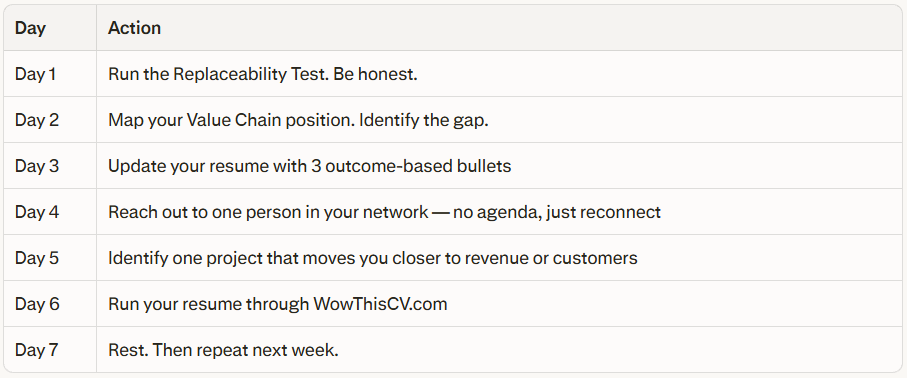
The companies moving fast on AI aren’t waiting for permission. The people who keep their jobs, or land better ones, won’t either.
Move before you have to.