Remote vs Office: Is a Bigger Paycheck Worth It?

Chasing a bigger number is easy.
Making a better career move is harder. Do the math, use the offer as leverage, and only switch if it clearly speeds up your trajectory, not just your paycheck.
If you want the 2025 data-backed reality on which path moves faster, read Local vs Remote Jobs: Which Gets You Hired Faster in 2025.
If you’re set on remote, this breakdown shows why those roles are harder now, and how to win one: Remote Jobs 2025: Why They’re Harder & How to Win One.
TL;DR
- Run the net-gain math. Commute + hidden costs + time lost can turn a $30k raise into ~$10–20k.
- Leverage before you leap. Present the offer, state a clean ask, and keep both doors open.
- Choose momentum over ego. Move only if scope, skills, and signal compound faster.
Trajectory > Salary: A Brutal Filter
If two or more are “No,” stay and negotiate.
- Scope: Will you own bigger problems, budgets, or a P&L? Yes/No
- Skills: Will you learn harder, marketable skills faster? Yes/No
- Signal: Will brand/manager/network open better doors next year? Yes/No
- Sustainability: Can you perform at your best with the commute/office cadence? Yes/No
You might find this filter prevents “nice title, small scope” traps.
The Market Reality (Use It, Don’t Fear It)
- Remote roles keep growing; pure office isn’t the default anymore.
- Remote often boosts productivity and reduces sick days.
- Office can increase visibility and promotion velocity.
- Translation: both paths work—pick the one that compounds career capital faster.
The Complete Execution Playbook: Scripts, Math & Worksheets
1. What Matters Only: Your Net Gain
Net Gain = New Total Comp – (Old Comp + Commute Costs + Hidden Work Costs + Value of Time Lost) + Benefit Differences
Break it down:
-
New Total Comp = base + bonus + equity (realistic value) + any signing.
-
Hidden Work Costs (typical ranges):
- Fuel/maintenance $3,000–$5,000/yr (or transit $1,500–$5,000/yr)
- Parking $800–$2,000/yr
- Wardrobe/dry cleaning $500–$1,500/yr
- Lunch/coffee $1,500–$3,000/yr
- Many remote workers effectively “save” up to ~$6,000/yr.
-
Time Lost = (commute hours/week × 52) × your hourly rate
- Hourly ≈ salary ÷ 2080
- 30 mins each way = 5 hrs/week → 260 hrs/yr
-
Benefit Differences = healthcare premiums, pension match, RSUs/ESPP, PTO—convert to $.
Quick Example
- Offer: +$30,000 base
- Commute: 30 mins each way → 5 hrs/week → 260 hrs/yr (FYI: the average US one-way commute is ~27 minutes.)
- Hourly rate: $150,000 ÷ 2080 ≈ $72/hr
- Time value lost: 260 × $72 = $18,720
- Hidden on-site costs: ~$6,000
- Rough net gain: $30,000 – ($18,720 + $6,000) ≈ $5,280
- Reality: That “+$30k” might feel like ~$5k after everything. You might find the math changes your decision.
3 Worked Examples
a. Senior AE (remote → office)
Offer +$25k | Commute 5 hrs/wk → 260 hrs/yr | Hourly $150k ÷ 2080 ≈ $72/hr
Time value $18,720 | Hidden costs $6,000 | Net gain $280 → basically zero.
Decision: Stay & negotiate.
b. PM hybrid (2 office days/week)
Offer +$20k | Commute 2 hrs/wk → 104 hrs/yr | Hourly $120k ÷ 2080 ≈ $57.7/hr
Time value ≈$5,991 | Hidden costs $2,500 | Net gain ≈ $11,509.
Decision: Move if Scope/Skills/Signal are strong or counter internally.
c. Ops Manager (full office, long commute)
Offer +$30k | Commute 7.5 hrs/wk → 390 hrs/yr | Hourly $90k ÷ 2080 ≈ $43.3/hr
Time value ≈$16,887 | Hidden costs $5,000 | Net gain ≈ $8,113.
Decision: Only move if Scope/Signal jump—and lock hybrid in writing.
2. Don’t “Choose” Yet—Leverage First
Your goal is optionality. Present the external offer, ask for a clean package, and let numbers do the work.
Calm leverage script (phone > email):
“I’m excited about my role here and want to stay. I received an external offer at $X with Y title and Z flexibility. If we can get to [your clean package: base, level/title, flexibility or equity], I’d be happy to commit here for the next 12 months.”
What actually works
- Lead with wanting to stay, not a threat.
- Present one clear package (no menu).
- Give a few business days for a response.
- If base stalls, ask for one-time bonus, RSUs, flexible cadence, training budget, or a written promotion path.
Mini-case (2–3 sentences):
A senior Account Executive I coached had a +$25k in-office offer. We ran the math (net ~$9k), then used it internally with a clean ask: +$15k base, 2 RSU grants, and 3 WFH days locked in writing. They matched most of it in 72 hours.
→ No commute. Better package.
For full phrasing you can copy, see the template in The Salary Script That Added $847K to Client Offers.
2a. Pushback Playbook (HR/Manager Objections → Responses)
Use right after “What actually works.”
- “We don’t do counteroffers.”
Totally fair. If we can’t move base, I’m open to a one-time bonus and RSUs. If we can also lock 3 WFH days in the letter, I’ll commit for 12 months. - “Budget is fixed this quarter.”
Then let’s stage it: sign-on $8k now, +$10k base effective Q1, and a dated promo path. I’ll confirm once we memorialize it in writing. - “Everyone’s in 4 days.”
Understood. If my results stay at/above target for 90 days, can we formalize 2–3 WFH days? Let’s put that review clause in the offer. - “We can match base, not title.”
Match base + RSUs now, and put a title change with written criteria by Month 6. If I hit the metrics, the title flips automatically. - “We’ll revisit later.”
I’m aligned—let’s add dates and metrics to the letter so we both know exactly when “later” happens.
2b. Copy/Paste Scripts (Internal + External)
Place after the mini-case.
Internal follow-up email (after the call)
Subject: Next steps & alignment
Body:
Thanks for the conversation today. Recap of my ask: base $X, RSUs $Y, and 3 WFH days, with a 12-month commitment from me. If base can’t move this cycle, I’m open to a $Z sign-on plus the base change dated for Q1. Happy to move fast once we have this in writing.
External “package, not parts” email
Subject: Package alignment
Body:
Excited about scope and team. If we can land at $X total comp, title Y, and 2 WFH days documented in the offer letter, I’ll sign this week. If helpful, I’m open to a sign-on vs base mix.
Thank-you + hold email (buys you time)
Subject: Appreciation & timing
Body:
Really appreciate the offer. I’m reviewing final details and can revert by [day/time]. If you need anything meanwhile, let me know.
3. Two Negotiation Playbooks (Copy/Paste)
A. With Your Current Employer
- Prep a one-pager: results (with numbers), market data, and the offer.
- Ask for base and one lever (title/level or equity/signing or flexibility).
- Sweetener: Offer a 12-month commitment after agreement.
- Fallbacks: signing bonus, RSUs, hybrid cadence in writing, conference/training budget, a dated promotion plan.
- Close: Get written confirmation (amounts, dates, cadence).
If your boss catches wind you’re interviewing, follow the safety checklist in Your Boss Found Out? Run a Stealth Job Search.
B. With the New Company
- Align scope first: title, success metrics, resources (team/budget).
- Negotiate the package, not line items: “If we land at $X total, Y title, 2 WFH days, I’ll sign.”
- Protect flexibility in the offer letter (not “team norms”).
- Accelerators: 90-day plan, skip-level mentor, tool/training budget.
- BATNA: Be ready to walk. You might find the number improves when you do.
C. Offer-Letter Clause Checklist
Add after “Protect flexibility in the offer letter.”
- Title & level (exact)
- Base, bonus targets, RSUs (grant timing/vesting)
- Hybrid cadence (days, exceptions, review clause at 90 days)
- Success metrics + 90-day plan (who signs off)
- Promotion path (criteria + date)
- Sign-on (amount, clawback rules)
- Relocation/parking/travel (stipends if any)
- Tools/training budget (annual amount)
D. Day-Of-Call Agenda (Internal)
Drop right before “Your Next Move.”
- Wins & impact (60–90 sec, numbers).
- Market reality (one line).
- The offer (facts only).
- The ask (one clean package).
- Flexibility if needed (sign-on vs base / staged raise).
- Close (12-month commitment once in writing).
- Next steps & timing (who, when).
E. Promotion-Path Template (Paste Into Letter)
“Title change to [Title] no later than [Date], contingent on: (1) [Metric A], (2) [Metric B], (3) manager sign-off. If criteria are met, title and comp adjust automatically effective [Date].”
4. Quick Decision Matrix (Green/Yellow/Red)
-
Take the new job if:
- Net gain ≥ $20k, and
- You pass 3+ of Scope/Skills/Signal/Sustainability, and
- Flex cadence is locked in writing.
-
Stay & negotiate if:
- Net gain < $15k, or
- You fail 2+ boxes, or
- The new role is mostly face time with thin learning.
-
Keep interviewing if:
- Both options feel lateral. Don’t rush from “meh” to “meh.”
Decision Matrix with Weights (Score It, Don’t Vibe It)
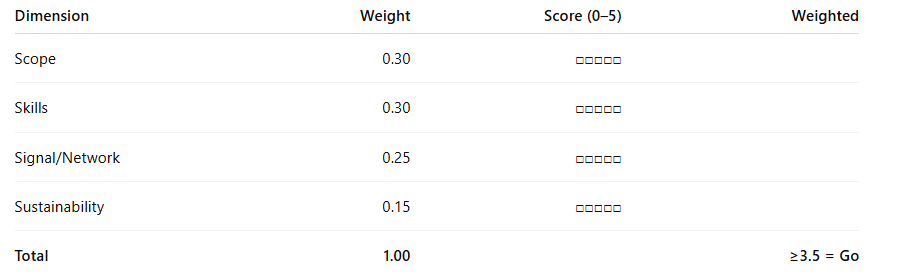
How to use: if Total ≥ 3.5 and Net Gain ≥ $20k, proceed—if hybrid is locked in writing.
5. Five Traps That Wreck Good Decisions
- Salary tunnel vision: Ignoring time, energy, and momentum.
- Vague offers: Nothing concrete on cadence, scope, or metrics.
- Title inflation: Fancy title, tiny scope. Bad trade.
- Fear of asking: Never testing internal leverage.
- Honeymoon bias: Overrating “fresh start,” underrating the grind.
If a hiring process crosses the line, this read will calibrate your threshold fast: If They Humiliate You In Hiring, Believe Them. (boringcareercoach.substack.com)
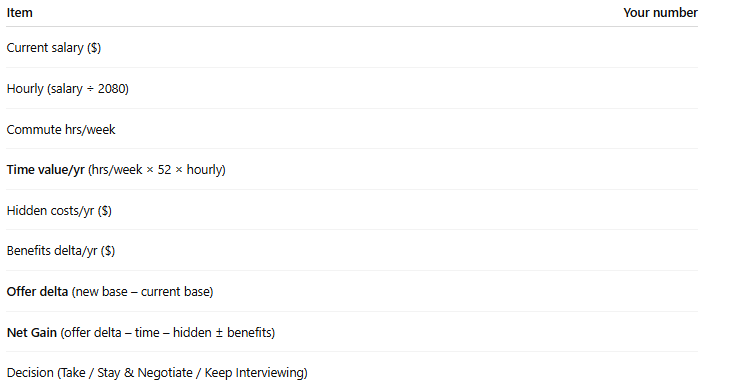
6. The 10-Minute Worksheet (Do This Today)
- Hourly rate: salary ÷ 2080.
- Commute time value: hours/week × 52 × hourly.
- Hidden costs: choose realistic numbers from the ranges above.
- Benefits delta: convert differences to $.
- Net Gain: run the equation.
- Trajectory filter: Scope, Skills, Signal, Sustainability (Yes/No).
- Decision: Take / Stay & Negotiate / Keep Interviewing.
- Next action: Book the internal conversation or ask the new company for specifics in writing.
Fill-In Worksheet (10 Minutes)
Your Next Move
Moving for money is easy. Moving for momentum is smarter.
Run the math. Leverage the offer. Choose the path that compounds scope, skills, and signal.
Sometimes the highest-ROI move is staying put—after you negotiate up. When you do jump, jump for acceleration, not just a bigger number on paper.