Stop Getting Good at Being Busy
Build leverage in your 20s, not dependency.

The Grind Trap
Everyone says “grind.”
Most people grind in the wrong direction. They stack hours. They don’t stack value.
Busy doesn’t compound. Leverage does.
Value Per Hour (VPH): Simple First
VPH = Value Created ÷ Hours Spent
“Value Created” can be:
- Money earned or saved
- Time you freed up (yours or the team’s)
- Problems you prevented
Transferable Skills That Raise Your Rate
Portable (leverage):
- Writing that persuades
- Presenting decisions clearly
- Managing chaos → shipped
- Senior relationships that open doors
- Negotiating scope, salary, terms
- Solving problems with no playbook
Non-portable (dependency):
- Internal tools no one else uses
- One-off processes only your team cares about
- Admin work that looks busy and builds nothing
The Litmus Test
Will this skill raise my rate outside this company within 12 months?
If no, de-prioritize.
Red Flags You’re Optimizing for Motion, Not Leverage
- Your calendar is full, but you can’t name what shipped last month.
- You’re learning tools that only your company uses.
- You can’t explain your value in three bullets.
- You’re waiting for someone else’s approval to prove your work.
Why Efficiency Beats Experience
Experience matters only if it makes you faster at valuable things.
Working 80 hours isn’t the goal. Creating more value per hour is. That’s what lets you earn more while working less.
It’s time to turn last month’s work → next month’s raise.
The Complete Value Per Hour System: Calculator, Scorecard, Scripts, and a 30-Day Plan
1. The VPH Calculator (copy/paste)
Start simple. Then go precise.
Level 1 (fast):
VPH = Value Created ÷ Hours Spent
Level 2 (precise):
VPH = (Revenue Impact + Time Saved + Risk Reduced) ÷ Hours Spent
- Revenue Impact: money in, churn prevented, pipeline created
- Time Saved: hours removed × blended hourly cost (use €50–€120/hr default)
- Risk Reduced: expected loss avoided × probability drop (keep it conservative)
How to compute in 10 minutes
-
List 3 wins from last month.
-
For each, estimate:
- Revenue added or churn prevented (€)
- Hours you saved × € cost
- A risk you lowered (and expected € avoided)
-
Add them up → divide by your hours spent.
-
Rank your work by VPH. Do more of the top 2. Cut the bottom 2.
Worked examples
- Product Manager: Killed a feature that would burn 400 eng hours @ €90/hr in 4 hours
→ Time Saved = €36k → VPH = €9k/hr - Customer Success Manager: Saved a €120k renewal in 6 hours → VPH = €20k/hr
- Marketer: New page adds €15k/mo. Took 10 hours to ship
→ Month 1 VPH = €1.5k/hr (and it compounds next months)
If you’re between roles, use the same math on projects from your portfolio—then align your first 30–60–90 using the cadence in this new-role playbook.
2. Weekly Leverage Scorecard (download-in-text)
Track this every Friday.
Aim for ≥70. Below 50 = motion, not progress.
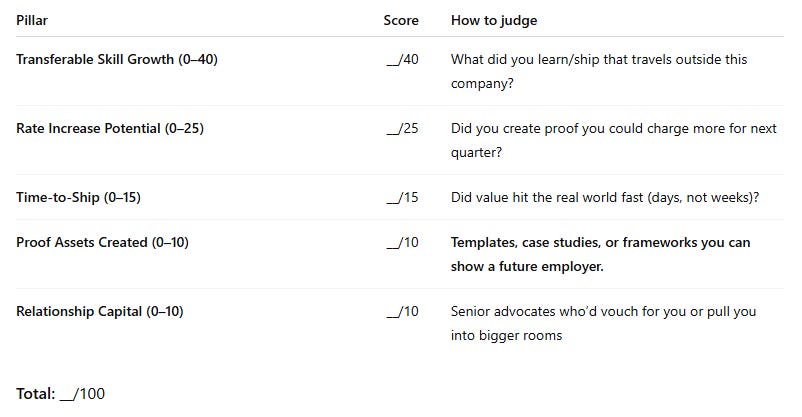
If you keep hopping jobs to “escape,” fix selection first with the system in how to pick and keep better jobs.
3. The 4D Ladder: What to Do With Your Task List
- Delete – kill tasks with no VPH.
- Delegate – hand off repeatable, low-VPH work.
- Design – build a template/system so it’s 5× faster next time.
- Do – ship the smallest valuable version now.
5-minute check: If a task can’t raise your VPH this month, it’s Delete/Delegate.
Stuck in politics? Apply the focus from the two-person strategy to cut noise and earn advocates.
4. Script Library (copy/paste)
Scope-cut (keeps outcomes, trims waste)
“Happy to help. To hit Friday without risking {X outcome}, let’s drop {Y} and focus on {Z}. If {Y} is mandatory, we’ll need to move the deadline or drop {Z}. Your call.”
Busywork deflection (re-prioritize by VPH)
“To maximize impact, here’s my stack ranked by VPH. Where should this sit, and what should I drop?”
Meeting kill (replace with proof)
“Could we skip this and I’ll send a one-page decision memo with options, trade-offs, and a recommendation by 4pm?”
Comp talk starter (anchors on proof)
“Over the last 90 days I added €__ and removed __ hours of team load. I’d like to align comp with that level of impact. What’s the path to €__ total comp?”
5. Proof Asset Templates (fill in the blanks)
A) One-Page Decision Memo
- Problem in one sentence
- 3 options with trade-offs
- Chosen path + why
- Risks + mitigation
- Next step + owner + date
B) Case Study (Retention / Revenue)
- Situation: baseline, risk, € at stake
- Action: what you shipped, in bullets
- Result: numbers (€, %, hours)
- Proof: screenshot/quote
- Reuse: the template/system you created
C) Playbook (Repeatable Work)
- Trigger (when to use)
- Steps (checklist)
- Assets (email copy, sheets, links)
- Owner + SLA
- “Done” definition + metric
Turn each win into one asset. Assets make interviews easy and raises likely.
6. Role-Specific Plays (do these next)
Early-Career CSM
- Stop: weekly status novels.
- Start: 3-email save sequence + renewal risk dashboard.
- Metric: churn prevented (€), risk reduced (%), hours saved.
- Proof asset: 1 renewal case study with screenshots.
Associate PM
- Stop: 10-page PRDs nobody reads.
- Start: one-page decision memo + a “kill list” of low-ROI backlog.
- Metric: hours saved, cycle time, outcomes shipped.
- Proof asset: 2 features killed, 1 launched with metrics.
Marketing Generalist
- Stop: fluffy “awareness” tasks.
- Start: 1 high-intent page + 1 clear offer + 1 follow-up sequence.
- Metric: pipeline added, CAC trend.
- Proof asset: before/after funnel with numbers.
If you’re deciding between roles or unsure what to build next, the decision filters inside the job-picking system will save months of churn.
7. 30-Day Leverage Plan
Week 1 — Audit & Focus
- List top 10 tasks from last 30 days.
- Estimate VPH for each. Circle top 2; cut bottom 3.
- Book 2×90-min deep-work blocks for one portable skill.
Week 2 — Ship Proof Fast
- Build one template/system that saves 5× time.
- Ship a one-page decision memo; get a yes/no.
- Create your first case study draft (numbers + screenshot).
Week 3 — Multiply Impact
- Roll the template to one teammate; measure hours saved.
- Run one scope-cut conversation using the script.
- Book a 20-min with a senior stakeholder; ask for one hard edit.
Week 4 — Convert to Career Assets
- Finalize your case study + playbook.
- Update resume bullets with € / % / hours.
- Book a comp/role growth chat anchored in your new proof.
- Fill the Weekly Leverage Scorecard. Aim for ≥70.
8. Resume & Interview Bullets (plug-and-play)
- “Retained a €120k at-risk account with a 3-email save plan; built a renewal dashboard used by 4 CSMs; reduced risk exposure by 27%.”
- “Cut 400 planned eng hours by killing 2 low-ROI features; shipped one high-intent release in 14 days; saved €36k and improved cycle time 22%.”
- “Launched a direct-response page + follow-up that added €45k pipeline in 60 days; reduced CAC 12%.”
Use one line per win. Lead with numbers. End with the asset you created.
9. FAQ: Common Pitfalls
-
“I don’t have revenue numbers”
Use time saved × blended hourly cost.
-
“My boss loves meetings”
Offer a memo with a decision by a set time.
-
“No one uses my template”
Sit with one teammate, install it, and measure hours saved. Then show the before/after.
10. Your 60-Minute Reset (today)
- 15 min: VPH on last month’s top 3 tasks
- 20 min: Draft one-page decision memo
- 15 min: Turn one win into a case study
- 10 min: Book a 20-min with a senior to review it
Busy is a habit. Leverage is a system.
Run the system!