The Comfortable Job That Quietly Kills Your Career
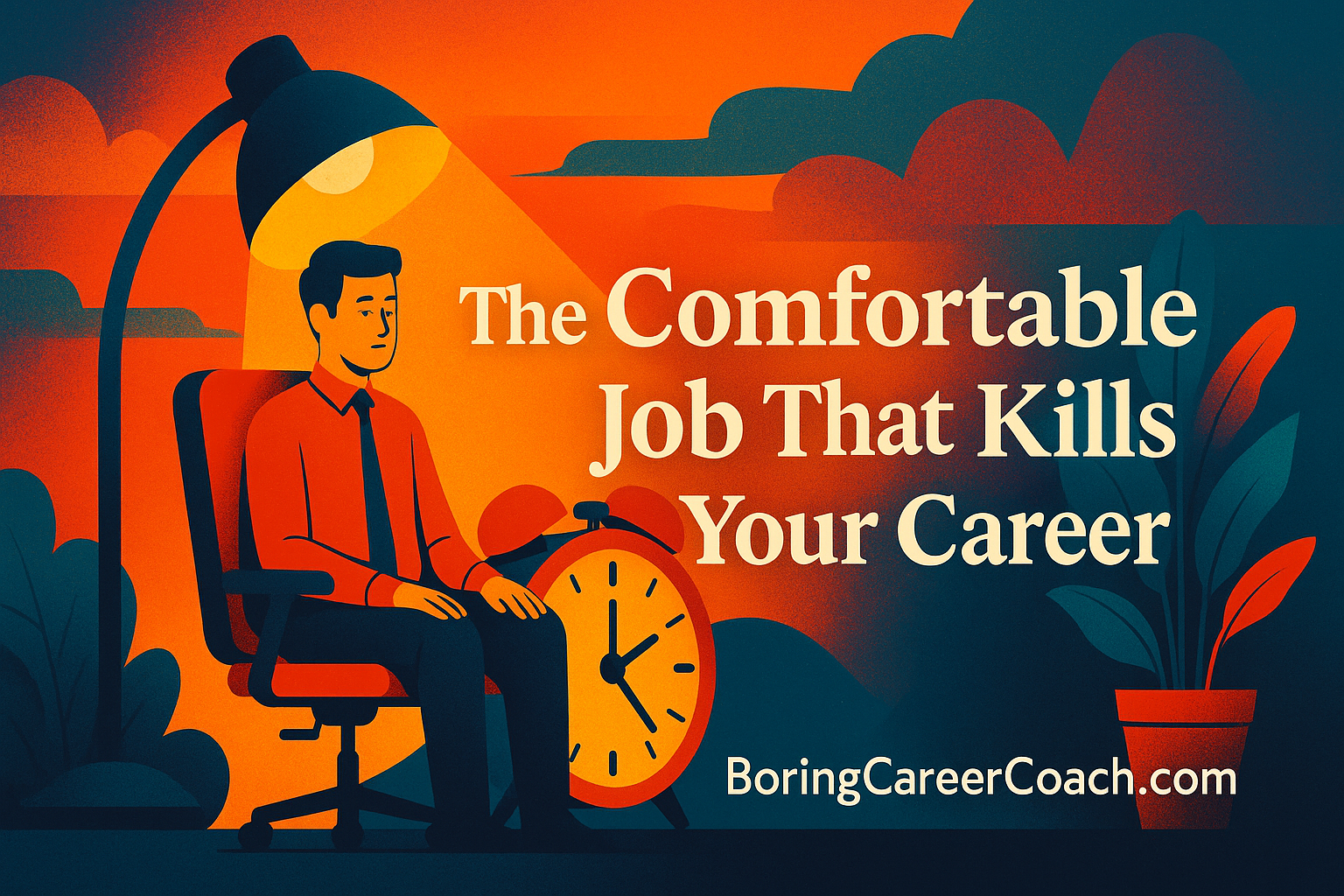
The most dangerous job you’ll ever have is not the toxic one.
It’s the comfortable one.
- Pay is fine
- Hours are fine
- Manager is fine
- Work is… easy
Nothing is bad enough to push you out.
Nothing is demanding enough to push you up.
So you stay.
A “few more months” becomes three years.
Same title. Same scope. Same story.
You’re not stuck because you’re weak.
You’re stuck because the role is just good enough.
And here’s the part most people miss:
This isn’t about fear, but control.
If you stay still while the market moves, you’re not “playing it safe.”
You’re handing your future to chance.
The Brutal Math Of Staying Comfortable
Let’s make this real.
You’ve seen the stats:
- 60% of pros report feeling trapped in their current roles.
- 51% say they’ve experienced zero career growth in the past year.
Now add this:
AI and automation are eating static skill sets first.
Not someday. Now.
You don’t need a research paper to get the point:
Half of what makes you “valuable” today could be outdated in 24 months. Comfort doesn’t pause that clock.
So when you sit in a role that doesn’t stretch you, here’s what actually happens:
- The market keeps raising the bar
- New tools, new workflows, new expectations
- Your experience stays flat while everyone else compounds
You think you’re “keeping your options open.”
You’re not.
You’re slowly pricing yourself out of the jobs you think you can still get.
If you want a deeper breakdown of how value really works at work, read my piece on career capital and why some people become “must keep” while others become replaceable.
Growth Isn’t Linear. Stagnation Isn’t Either.
The big lie is that careers move in straight lines.
“They promoted me every 2–3 years, so I’m on track.”
That’s not how this works.
Growth compounds:
- One new skill leads to a harder project
- That project leads to more scope
- That scope leads to a better title and stronger offers
Each step multiplies the next one.
Stagnation compounds too:
- You repeat the same work
- You stop chasing new skills
- Your resume becomes a “copy-paste” of the same year
Then one day you’re job hunting, and it hits you:
You’re not competing with who you were two years ago.
You’re competing with everyone who kept stacking small wins while you stayed comfortable.
That’s the real cost of waiting.
If promotions feel random in your company, my breakdown on why promotions aren’t about effort will make a lot of this click.
Why This Matters For Your Career Growth
If you’ve been with me for a while, you know my rule:
You don’t get paid for years served. You get paid for proof of growth.
A “good” role with no growth feels safe because:
- The paycheck arrives
- The calendar isn’t crazy
- Nobody is pushing you
But from a hiring manager’s seat, here’s what I actually see when I review your CV as a coach:
- Same title for 3–5 years
- No real change in impact or scope
- Vague bullets that could belong to anyone
That doesn’t say “loyal and stable.”
It says “stopped moving.”
If you want real leverage in this market, you need 3 things:
- Skills that didn’t exist on your CV two years ago
- Proof that you can handle higher stakes
- A story that shows direction, not just survival
Comfort kills all three.
If you want help turning that story into interviews, my playbook on getting findable and earning recruiter callbacks in 90 days walks you through it step by step.
How To Break Out: A Simple System I Use With Clients
Here’s the exact framework I walk through with people who feel “fine, but stuck.” If that sounds like where you are, here’s how the coaching works.
You don’t need motivation.
You need structure.
1. Upgrade one core skill every 90 days
Not “learn a bit of everything.”
Pick one skill that shows up in real job descriptions you’d actually want.
Examples:
- A specific tool (HubSpot, Salesforce, Figma, Looker)
- A concrete capability (running discovery calls, building dashboards, leading QBRs, writing SQL, shipping experiments)
Build it in public: ship something with it. If it doesn’t show up in your CV, it doesn’t count.
If you’re not sure which skills to target, my 2025 job market breakdown will give you a clear read on where demand is moving.
2. Take one uncomfortable project inside your current role
Don’t wait for permission.
- Volunteer to fix a broken process
- Lead a small experiment
- Own one metric for a quarter
If your job has no room for this, that’s not a green flag. That’s your sign to plan an exit, using the roadmap in the Next Job Playbook so you don’t wing it.
3. Track proof, not busyness
I tell every client to keep a simple “Proof Log.”
Every week, answer:
- What did I improve?
- What did I finish?
- What number moved because of me?
You’re not collecting tasks. You’re collecting evidence.
That evidence is what gets you paid. It’s also what makes your resume sound like a real operator, not a job description.
If your bullets are still fluff, run them through my resume math teardown to fix that.
4. Update your resume every quarter (even if you’re not applying)
Open the file.
Force yourself to add real wins.
If you stare at it for 10 minutes and there’s nothing meaningful to add, that’s your wake-up call.
Do not ignore it.
When you’re ready to turn that resume into callbacks, combine this with the 10-application system, so you stop spamming and start sending targeted, high-odds applications.
5. Keep one foot in the market
Your company is not the market.
Every month:
- Scan job postings you’d actually apply to
- Note the skills and tools that repeat
- Compare them to your Proof Log
The gap between those two is your roadmap.
Not a podcast. Not “follow your passion.”
The actual skills and impact you need to stay relevant.
If you’re not sure whether to stay local or chase remote, my breakdown on local vs remote jobs in 2025 will help you pick the lane that fits your goals.
Your Next Move
If you see yourself in this, nothing is broken.
You’re not lazy.
You’re not behind saving.
You’re just in a role that rewards you for staying the same.
You can change that.
Start small:
- Choose one skill to upgrade in the next 90 days
- Take on one project you’re not fully ready for
- Start your Proof Log this week
Your career won’t blow up overnight.
But if you treat growth as compounding, not random, you shift from “I hope my job is safe” to “I know I can land the next one.”
That’s the whole game.
Not passion.
Not luck. Staying valuable on purpose.